Why r-MicronQuick and Evolon® technology deliver hygiene outcomes and total cost of ownership that generic microfiber simply cannot match.
|
99.99%
Bacteria & virus removal
|
400+
Washable reuse cycles
|
0.075 dtex
Fiber fineness (Pie 32)
|
70%
Recycled PES
|
Why does microfiber quality actually matter?
Most procurement decisions treat microfiber cloths as a generic consumable. They are not. Cleaning performance, hygiene outcomes, and total cost per clean vary dramatically depending on the underlying fiber technology — and specifically, whether that technology is non-woven or knitted.
A low-cost knitted cloth that requires detergent, degrades after 50 washes, and traps dirt in its loops is not a saving — it is a liability.
Vileda Professional's r-MicronQuick is built on Freudenberg's proprietary Evolon® non-woven technology — a patented, independently tested microfiber platform that delivers measurable results across the four dimensions that matter most to facility managers: performance, hygiene, durability, and sustainability.
| eg. Cotton |
Microfibre |
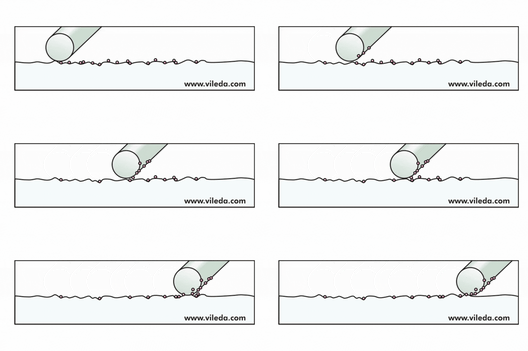 |
 |
What is Evolon® Pie 32 — and why does it outperform knitted microfiber?
Fiber fineness is the defining technical variable in microfiber performance: it measures the weight in grams of 10 km of fiber. A microfiber is classified as anything at or below 1 dtex. The Evolon® Pie 32 process produces fibers go down to 0.075 dtex — up to 100 times thinner than a human hair and significantly finer than most market alternatives.
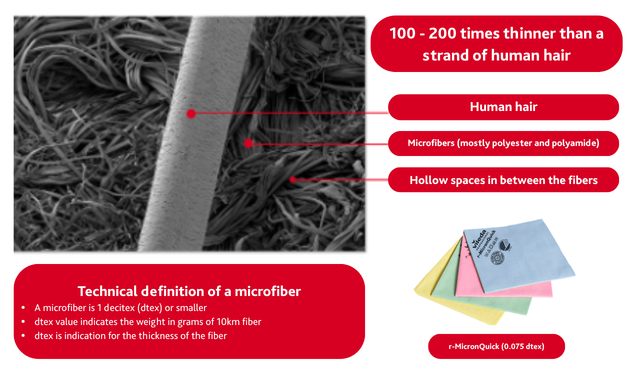
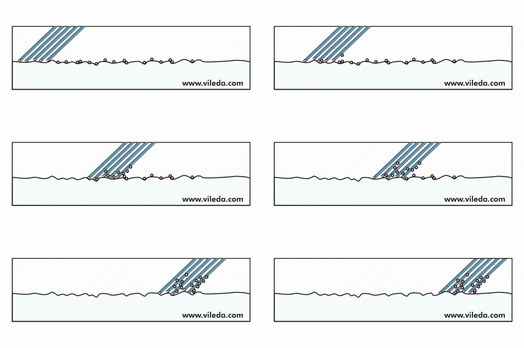
How 'Pie 32' Evolon process works
Freudenberg's patented hydropower splitting process takes a bi-component parent fiber (polyester + polyamide) and splits it into 32 ultra-fine filaments using high-pressure water jets. The resulting non-woven structure bonds fibers flat — unlike knitted cloths where fibers are looped and meshed into a thick, absorbent pile.
The flat, bonded structure creates greater surface contact per stroke, scraping and trapping particles mechanically in the capillary spaces between filaments. This is the mechanism that makes water-only cleaning effective — no detergent required.
What does non-woven construction actually mean for performance?
The non-woven structure of r-MicronQuick drives four direct operational advantages over knitted alternatives:
1. Superior soiling release during laundering
In knitted cloths, dirt particles, hair, and debris become trapped deep within the loops and mesh during use and washing. Non-woven fibers are bonded flat: they open up fully during the wash cycle, releasing 100% of the collected soiling. The result is a genuinely clean cloth at the start of every shift — not one carrying residual contamination from the last wash.
2. Streak-free wiping and ultra-fast drying
The smooth, flat structure of non-woven microfiber wipes surfaces evenly without leaving micro-droplets or lint behind. Knitted cloths hold excess water in their loops, increasing drying time and the associated risk of bacterial proliferation on a damp surface. r-MicronQuick dries significantly faster, reducing that window of risk.
3. Lower chemical consumption per square metre
The smooth glide of non-woven material distributes liquid evenly across a surface. Less solution or disinfectant is needed to cover the same area compared to a knitted cloth, where chemical is absorbed and retained within the pile. Over time, this directly reduces chemical spend and waste — relevant for both cost control and environmental compliance.
4. Maximised laundry efficiency
Because the non-woven structure is thinner and lighter than knitted alternatives, more cloths fit into a single washing machine cycle. For high-volume cleaning operations, this reduces laundry costs, energy consumption, and cycle time — a direct operational saving that compounds across a contract.
What do the independent test results show?
All performance claims for r-MicronQuick are backed by third-party laboratory testing — not internal benchmarks.
99.99% bacteria removal — Pseudomonas aeruginosa & Staphylococcus aureus on vinyl surfaces (3rd party lab)
- 99.99% virus removal — Bovine coronavirus on vinyl surfaces (3rd party lab)
- Biofilm risk eliminated — detergent residue left on surfaces actively promotes biofilm formation; water-only cleaning removes this pathway entirely
- Antibiotic resistance — over-reliance on chemical disinfectants in routine cleaning accelerates microbial resistance; mechanical removal with microfiber reduces this systemic risk
- Sensitive environments — in healthcare and food service, no chemical residue means no risk of surface contamination or occupant exposure between cleaning cycles
400-wash durability — tested with Ozonit Performance, an RKI-listed chemical-thermal disinfection procedure
70% recycled post-consumer polyester — all recycled content made from post-consumer plastic
Ideal for bio-cleaning protocols — flat non-woven structure maximises direct mechanical action against biofilms, effective with water alone in healthcare and sensitive environments
Important: these results confirm hygienic cleaning — effective mechanical removal of pathogens. This is not the same as chemical disinfection and should not be communicated as such.
Why does water-only cleaning matter beyond cost?
Reducing or eliminating detergent is not only a cost decision — it has direct implications for health, hygiene safety, and long-term microbial risk:
What is the real ROI of a 400-wash cloth?
The r-MicronQuick cloth is engineered to withstand up to 400 industrial wash cycles without loss of cleaning performance. It contains 70% recycled polyester, is certified by the Nordic Swan ecolabel, and is manufactured in Freudenberg's European facilities.
Quick comparison: r-MicronQuick vs. standard microfiber
|
Criterion
|
r-MicronQuick
|
General Microfiber
|
|
Technology
|
Evolon® Pie 32 — patented hydropower splitting
|
Standard extrusion, no proprietary process
|
|
Fiber fineness
|
0.075 dtex (bi-component PES + PA)
|
0.3–1 dtex typical
|
|
Bacteria removal
|
99.99% (certified)
|
Variable / unverified
|
|
Virus removal
|
99.99% (certified)
|
Rarely tested
|
|
Biofilm risk
|
Eliminated — no detergent residue left on surface
|
Detergent residue can promote biofilm formation
|
|
Wash cycles
|
Up to 400×
|
50–100× typical
|
|
Recycled content
|
70% recycled polyester
|
Usually none
|
|
Construction
|
Non-woven — lightweight, shape-retaining
|
Often knitted or woven terry
|
|
Soiling release
|
Flat fibers open fully during wash — 100% dirt release
|
Loop structure traps particles, harder to fully clean
|
|
HACCP colour coding
|
4 Colours — Blue, Red, Green, Yellow
|
Often limited
|
The Bottom Line
Specifying r-MicronQuick is not a premium choice — it is the compliant, cost-effective, and defensible choice when hygiene outcomes, sustainability targets, and total cost of ownership are measured correctly.
Evaluate on cost-per-clean, not cost-per-cloth.

 Article

%20Kopie.png?width=580&height=435&name=r-MicronQuick_4_Colors_550px_435px%20(1)%20Kopie.png)
.jpg)